Fraction Calculator — Add, Subtract, Multiply and Divide Fractions
Enter two fractions, select an operation and the result appears with the simplified fraction, mixed number, decimal equivalent and a full step-by-step solution. Seven modes — add, subtract, multiply, divide, simplify, mixed number conversion and decimal conversion.
How to Add Fractions
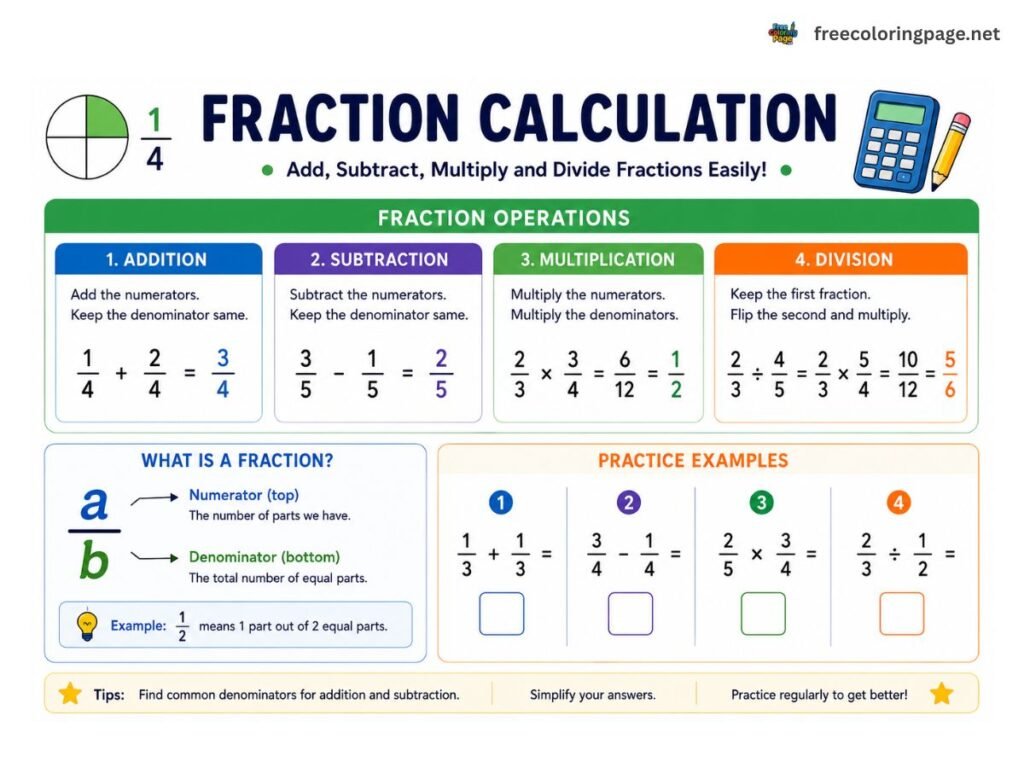
Adding fractions requires a common denominator — both fractions must have the same bottom number before the numerators can be added.
Same denominator: 2/5 + 1/5 = 3/5 — add numerators directly.
Different denominators:
Step 1: Find the LCM of the denominators. LCM of 4 and 6 = 12
Step 2: Convert both fractions. 1/4 = 3/12 · 1/6 = 2/12
Step 3: Add the numerators. 3/12 + 2/12 = 5/12
Step 4: Simplify if possible. GCD of 5 and 12 = 1 — already in simplest form.
Result: 1/4 + 1/6 = 5/12 = 0.4167
How to Subtract Fractions
Subtracting follows the same steps as addition — find the LCM, convert, subtract. The common mistake students make is when the first numerator is smaller than the second after converting.
Example where students go wrong: 1/3 − 1/2
LCM of 3 and 2 = 6 1/3 = 2/6 · 1/2 = 3/6
2/6 − 3/6 = −1/6
The answer is negative — you subtracted a larger fraction from a smaller one. This trips up students who expect a positive result. The fraction calculator handles negative results automatically.
How to Multiply Fractions
Multiplying fractions is the simplest operation — multiply numerators together and denominators together. No common denominator needed.
Formula: a/b × c/d = (a×c) / (b×d)
Example: 2/3 × 3/4 = 6/12 = 1/2
Cross-cancelling tip: Before multiplying, cancel any numerator with any denominator that share a common factor. In 2/3 × 3/4 the 3s cancel — leaving 2/1 × 1/4 = 2/4 = 1/2. This keeps numbers smaller and avoids simplifying at the end.
How to Divide Fractions
Dividing by a fraction is the same as multiplying by its reciprocal — flip the second fraction and multiply.
Formula: a/b ÷ c/d = a/b × d/c
Example: 3/4 ÷ 1/2 Flip: 1/2 → 2/1 Multiply: 3/4 × 2/1 = 6/4 = 3/2 = 1½
The memory aid: Keep, Change, Flip — keep the first fraction, change ÷ to ×, flip the second fraction.
Decimal to Fraction Conversion – Using fraction calculator
Count the decimal places, use 10^places as the denominator, then simplify.
Example: 0.75 → 2 decimal places → 75/100 → GCD = 25 → 3/4
Common conversions:
|
Decimal |
Fraction |
|---|---|
|
0.1 |
1/10 |
|
0.125 |
1/8 |
|
0.25 |
1/4 |
|
0.333… |
1/3 |
|
0.5 |
1/2 |
|
0.666… |
2/3 |
|
0.75 |
3/4 |
|
0.875 |
7/8 |
How to Simplify Fractions
A fraction is in simplest form when the numerator and denominator share no common factor other than 1. Divide both by their GCD.
Example: 18/24
GCD of 18 and 24 = 6 18 ÷ 6 = 3 · 24 ÷ 6 = 4 18/24 = 3/4
Quick check: If both numbers are even divide by 2 and repeat. Then check divisibility by 3, 5, 7 in turn. Stop when no common factor remains.
Mixed Numbers and Improper Fractions
A mixed number combines a whole number and a fraction — like 2⅓. An improper fraction has a numerator larger than the denominator — like 7/3. Both represent the same value.
Mixed → Improper: Multiply the whole number by the denominator, add the numerator. 2⅓: (2 × 3) + 1 = 7 → 7/3
Improper → Mixed: Divide numerator by denominator. Quotient = whole number, remainder = new numerator. 7 ÷ 3 = 2 remainder 1 → 2⅓
Other Free Tools
- Average Calculator — Mean, median, mode and range
- GPA Calculator — Grade point average on the US 4.0 scale
- Percentage Calculator — Percentage of a number, change and markup
- Ratio Calculator — Simplify, scale and solve ratio problems
Frequently Asked Questions
About This Fraction Calculator
This free fraction calculator is part of CalcDaysTime — a free suite of date, time and maths tools. All calculations run entirely in your browser. No data is sent to our servers, stored or shared with anyone.
Disclaimer: Results follow standard fraction arithmetic rules. Some teachers require specific methods — such as always finding the LCM rather than multiplying denominators directly. Always verify against your institution’s expected approach before submitting academic work.