
Days Until
New Year 2027
Friday · 1 January 2027
Progress through 2026 toward New Year's Day
Other Countdowns
Days Until New Year 2027
New Year 2027 falls on Friday, 1 January 2027. The live days until New Year countdown above shows the exact day, hours, minutes and seconds until midnight strikes. It updates every second and automatically advances to the following year once New Year has passed.
When Is New Year 2027? — Days Until New Year Explained
New Year’s Day is always 1 January. In 2027 it falls on Friday, 1 January 2027.
New Year’s Day is a public holiday in the United States, United Kingdom, Australia, Canada, Pakistan, India and most countries worldwide. Government offices, banks, schools and many businesses are closed. When New Year falls on a Friday it creates a natural three-day weekend — useful to know when booking travel or planning deliveries that week.
New Year 2027 — Key Dates
Event |
Date |
|---|---|
|
New Year’s Eve |
31 December 2026 |
|
New Year’s Day |
Friday, 1 January 2027 |
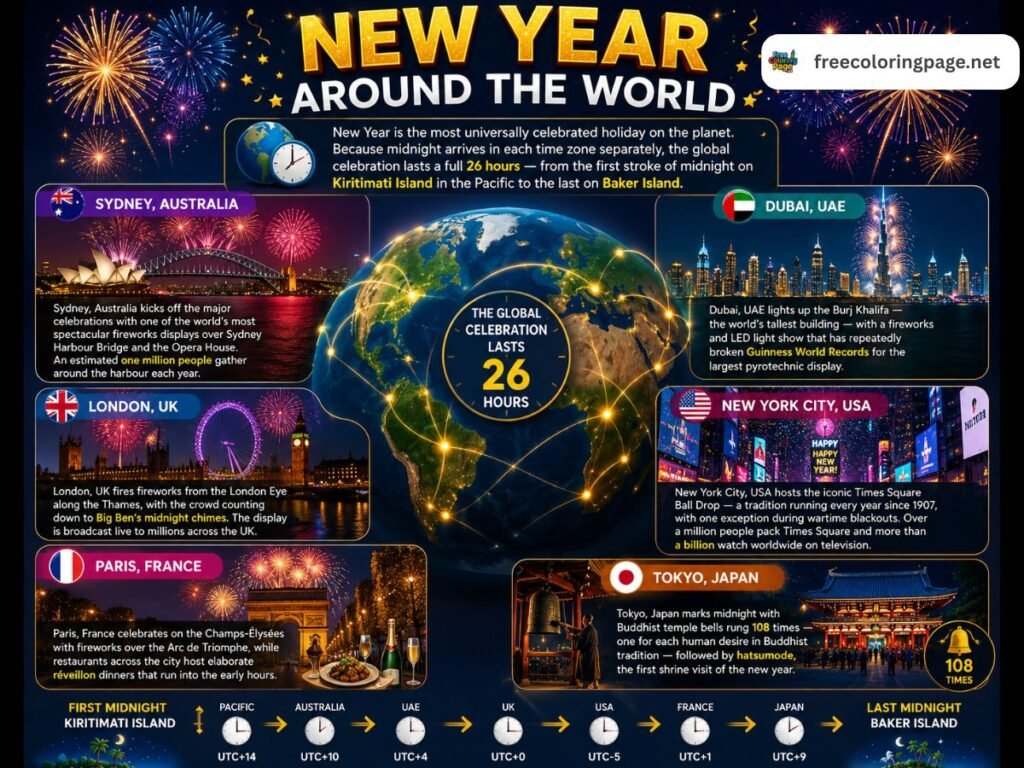
New Year Celebrations Around the World
New Year is the most universally celebrated holiday on the planet. With so many people searching for days until New Year every December, it is clear just how eagerly the world anticipates the countdown. Because midnight arrives in each time zone separately, the global celebration lasts a full 26 hours — from the first stroke of midnight on Kiritimati Island in the Pacific to the last on Baker Island.
Sydney, Australia kicks off the major celebrations with one of the world’s most spectacular fireworks displays over Sydney Harbour Bridge and the Opera House. An estimated one million people gather around the harbour each year.
Dubai, UAE lights up the Burj Khalifa — the world’s tallest building — with a fireworks and LED light show that has repeatedly broken Guinness World Records for the largest pyrotechnic display.
London, UK fires fireworks from the London Eye along the Thames, with the crowd counting down to Big Ben’s midnight chimes. The display is broadcast live to millions across the UK.
New York City, USA hosts the iconic Times Square Ball Drop — a tradition running every year since 1907, with one exception during wartime blackouts. Over a million people pack Times Square and more than a billion watch worldwide on television.
Paris, France celebrates on the Champs-Élysées with fireworks over the Arc de Triomphe, while restaurants across the city host elaborate réveillon dinners that run into the early hours.
Tokyo, Japan marks midnight with Buddhist temple bells rung 108 times — one for each human desire in Buddhist tradition — followed by hatsumode, the first shrine visit of the new year.
Why Do We Celebrate New Year on 1 January?
People have been counting days until New Year for centuries — though the date was not always universal. Ancient Egyptians began their year when the Nile flooded, Babylonians marked new year in spring, and the original Roman calendar started the year in March.
It was Julius Caesar who fixed 1 January as the start of the new year in 46 BC, naming the first month January after Janus — the Roman god of beginnings, gates and time, typically depicted with two faces: one looking back at the year past and one forward into the year ahead.
The Gregorian calendar, introduced by Pope Gregory XIII in 1582 and now the global standard, kept 1 January as New Year’s Day. Though many countries resisted for centuries — Britain did not adopt it until 1752 — the Gregorian calendar eventually unified the date worldwide.
New Year Around Different Calendars
1 January is not the only New Year in the world. Several major traditions mark their own:
Chinese New Year — falls between late January and mid-February, based on the lunisolar calendar. Each year is associated with one of twelve zodiac animals. Celebrated with lanterns, red envelopes and family gatherings across China and Chinese communities worldwide.
Islamic New Year (Hijri New Year) — falls on the first day of Muharram, the first month of the Islamic lunar calendar. Because the Islamic calendar is purely lunar with no correction months, it shifts approximately 11 days earlier each Gregorian year.
Jewish New Year (Rosh Hashanah) — falls in September or October. It marks the beginning of the High Holy Days and is observed with synagogue services, apples dipped in honey and the sounding of the shofar.
Persian New Year (Nowruz) — celebrated on the spring equinox, around 20-21 March. Observed in Iran, Afghanistan, parts of Central Asia and diaspora communities worldwide. One of the oldest new year celebrations in existence, with roots going back over 3,000 years.
Tamil New Year (Puthandu) — falls on 14 April, marking the first day of the Tamil month Chithirai according to the Tamil solar calendar.
Many people celebrate more than one new year depending on their cultural, religious or family traditions.
Other Holiday Countdowns
- Days Until Christmas — Live countdown to 25 December 2026
- Days Until Halloween — Live countdown to 31 October 2026
- Days Until Thanksgiving — Live countdown to Thursday, 26 November 2026
- Days Until Easter — Live countdown to Sunday, 28 March 2027
- Days Until Valentine’s Day — Live countdown to Sunday, 14 February 2027
Frequently Asked Questions
About This Days Until New Year Countdown
This days until New Year countdown is part of CalcDaysTime — a free suite of date, time and maths tools. It updates every second in real time and automatically advances to the next new year once the current one passes. No data is collected or stored.