
Ratio Calculator — Simplify, Scale and Solve Ratio Problems
Enter your values into the ratio calculator, select a mode and the result appears with a full step-by-step solution. Six modes — simplify, scale, solve for a missing value, divide a total by a ratio, compare two ratios and generate equivalent ratios.
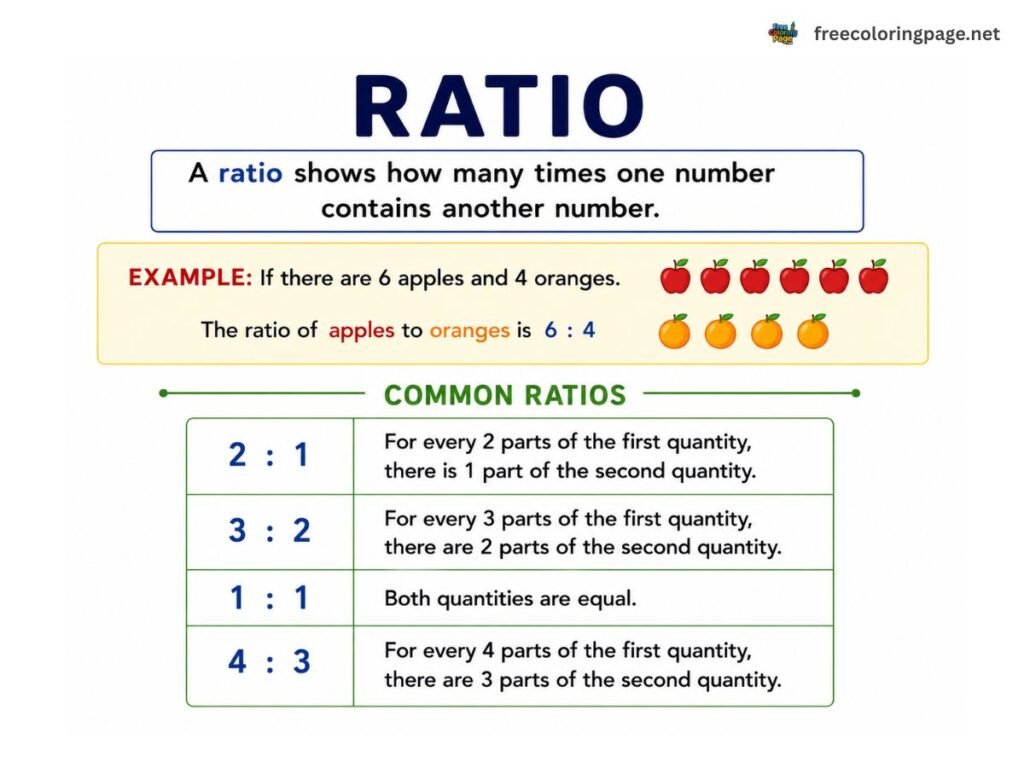
What Is a Ratio?
A ratio compares two quantities by showing how much of one there is relative to the other. Written as A:B (read “A to B”), it answers the question: for every A of one thing, how much of the other?
Example: A recipe uses 2 cups of flour for every 1 cup of sugar. The ratio is 2:1.
If you double the recipe — 4 cups flour and 2 cups sugar — the ratio is still 2:1. The amounts changed but the relationship stayed the same. This is what makes ratios powerful: they describe a relationship, not a fixed quantity.
Part-to-Part vs Part-to-Whole Ratios
This is the distinction that trips up most students and the source of the most common ratio exam mistakes.
Part-to-part ratio compares one group directly to another group. Part-to-whole ratio compares one group to the total of all groups.
Part-to-part ratio compares one group directly to another group. Part-to-whole ratio compares one group to the total of all groups.
Example: A class has 12 boys and 8 girls.
- Part-to-part: boys to girls = 12:8 = 3:2
- Part-to-whole: boys to total students = 12:20 = 3:5
The question wording tells you which to use:
- “What is the ratio of boys to girls?” → part-to-part (3:2)
- “What fraction of the class are boys?” → part-to-whole (3:5 = 3/5)
Always read the question carefully — “to girls” means part-to-part, “of the class” means part-to-whole.
How to Simplify a Ratio
Simplifying a ratio means dividing both sides by their GCD until no common factor remains.
Example: Simplify 18:24
GCD of 18 and 24 = 6 18 ÷ 6 = 3 · 24 ÷ 6 = 4 18:24 = 3:4
Check: 3 and 4 share no common factor other than 1 — fully simplified.
With decimals: Multiply both sides until you have whole numbers, then simplify. 1.5:2.5 → multiply both by 2 → 3:5 → already simplified.
How to Solve for a Missing Value
When you have two equivalent ratios with one value missing use cross multiplication to find it.
Formula: If A:B = C:D then A × D = B × C
Example: 3:4 = 9:?
3 × ? = 4 × 9 = 36 ? = 36 ÷ 3 = 12
Check: 3:4 = 9:12 — both simplify to 3:4 ✅
This is called a proportion. Cross multiplication always works for finding the missing term.
How to Write a Ratio — Three Ways
The same ratio can be written in three equivalent forms:
|
Form |
Example |
Used in |
|---|---|---|
|
Colon notation |
3:4 |
Maths, everyday use |
|
Fraction |
3/4 |
Proportion calculations |
|
Words |
3 to 4 |
Written descriptions |
All three mean the same thing. Colon notation is most common in ratio problems. The fraction form is used when solving proportions algebraically. The word form appears in written exam questions.
How to Divide a Total in a Given Ratio
Formula:
- Add the ratio parts — this is the total number of shares
- Divide the total by the number of shares — this is the value of one share
- Multiply by each part
Example: Split £120 in the ratio 3:2
Total shares: 3 + 2 = 5 One share: £120 ÷ 5 = £24 Part A: 3 × £24 = £72 Part B: 2 × £24 = £48
Check: £72 + £48 = £120 ✅ and 72:48 = 3:2 ✅
Real uses:
- Splitting a restaurant bill based on what each person ordered
- Dividing profit between business partners based on investment
- Allocating project hours between team members
How to Solve Ratio Word Problems
Word problems are where students most commonly lose marks. Here is a complete worked example from start to finish.
Problem: A paint mixture uses red and white paint in the ratio 2:5. A decorator needs 21 litres in total. How many litres of each colour are needed?
Step 1: Identify the ratio — 2:5 (red:white)
Step 2: Find the total shares — 2 + 5 = 7
Step 3: Find the value of one share — 21 ÷ 7 = 3 litres per share
Step 4: Multiply by each part — Red: 2 × 3 = 6 litres White: 5 × 3 = 15 litres
Check: 6 + 15 = 21 ✅ and 6:15 = 2:5 ✅
The key is always the same: find the total shares, find the value of one share, then multiply. Use the Divide by Ratio tab in this ratio calculator for any similar problem.
Ratio vs Fraction — What Is the Difference?
A fraction represents a part of a whole — 3/4 means 3 out of 4 equal parts.
A ratio compares any two quantities to each other — 3:4 means for every 3 of one thing there are 4 of another.
Example: In a bag with 3 red and 4 blue sweets:
- Ratio of red to blue = 3:4 (part-to-part — comparing the two groups)
- Fraction of sweets that are red = 3/7 (part-to-whole — one group out of the total)
The ratio 3:4 does not equal the fraction 3/4. The fraction equivalent of the ratio 3:4 as a part of the whole is 3/7 — because there are 7 sweets in total.
Ratios in Real Life
Cooking — a bread recipe with flour to water at 5:3 scales proportionally. Double the recipe: 10:6. The ratio stays the same, the quantities change.
Maps — a scale of 1:50,000 means 1cm on the map = 50,000cm (500m) in reality.
Finance — a debt-to-income ratio of 1:3 means for every £1 of debt there is £3 of income. Lenders use this to assess mortgage risk.
Photography — the 16:9 aspect ratio means 16 units wide for every 9 units tall. 1920×1080 pixels maintains exactly 16:9.
Pharmacy — adrenaline for anaphylaxis is supplied at 1:1000 — 1mg of adrenaline per 1000mL of solution.
Proportion Calculator — Solve A:B = C:D
A proportion is a statement that two ratios are equal. Written as A:B = C:D or A/B = C/D, it means the relationship between A and B is the same as the relationship between C and D.
This ratio calculator doubles as a proportion calculator — use the Solve for X tab to find any missing value in a proportion instantly.
Proportion formula: A × D = B × C (cross multiplication)
Example: 3:4 = 9:? 3 × ? = 4 × 9 = 36 ? = 36 ÷ 3 = 12
Check: 3:4 = 9:12 — both simplify to 3:4 ✅
Direct Proportion vs Inverse Proportion
Direct proportion — as one value increases the other increases at the same rate. If A doubles, B doubles. Written as A ∝ B.
Example: 5 workers paint a house in 12 days. How long for 10 workers? More workers = less time → this is NOT direct proportion.
Inverse proportion — as one value increases the other decreases. If A doubles, B halves. Written as A ∝ 1/B.
Formula: A₁ × B₁ = A₂ × B₂
Example: 5 workers take 12 days → 10 workers take ? days 5 × 12 = 10 × ? 60 = 10 × ? ? = 6 days
More workers → fewer days — a classic inverse proportion problem.
How to tell which type:
- More of A means more of B → direct proportion
- More of A means less of B → inverse proportion
Common direct proportion examples: speed and distance, price and quantity, workers and total output. Common inverse proportion examples: workers and time, speed and travel time, pipes and filling time.
Other Free Tools
- Fraction Calculator — Add, subtract, multiply and divide fractions
- Percentage Calculator — Percentage of a number, change and markup
- Average Calculator — Mean, median, mode and range
- Unit Converter — Convert length, weight, temperature and more
Frequently Asked Questions
About This Ratio Calculator
This free ratio calculator is part of CalcDaysTime — a suite of date, time and maths tools. All calculations run entirely in your browser. No data is sent to our servers, stored or shared with anyone.
Disclaimer: Results are mathematically accurate for standard ratio arithmetic. For pharmaceutical, financial or engineering applications always verify against professional standards.