
Square Root Calculator — Find the Square Root of Any Number
Enter any number and the square root calculator finds the positive root, negative root, simplified radical form and decimal result instantly — with a full step-by-step solution. Switch between square root, cube root, 4th root, 5th root or any nth root using the tabs above.
What Is a Square Root?
The square root of a number is the value that, when multiplied by itself, gives that number.
√9 = 3 because 3 × 3 = 9
√25 = 5 because 5 × 5 = 25
The symbol √ is called a radical sign. The number inside it is called the radicand.
Every positive number has two square roots — one positive and one negative:
√16 = +4 and −4 because both 4 × 4 = 16 and (−4) × (−4) = 16
When people say “the square root of 16” they usually mean the positive root (+4), which is called the principal square root.
How to Subtract Fractions
Subtracting follows the same steps as addition — find the LCM, convert, subtract. The common mistake students make is when the first numerator is smaller than the second after converting.
Example where students go wrong: 1/3 − 1/2
LCM of 3 and 2 = 6 1/3 = 2/6 · 1/2 = 3/6
2/6 − 3/6 = −1/6
The answer is negative — you subtracted a larger fraction from a smaller one. This trips up students who expect a positive result. The fraction calculator handles negative results automatically.
How to Multiply Fractions
Multiplying fractions is the simplest operation — multiply numerators together and denominators together. No common denominator needed.
Formula: a/b × c/d = (a×c) / (b×d)
Example: 2/3 × 3/4 = 6/12 = 1/2
Cross-cancelling tip: Before multiplying, cancel any numerator with any denominator that share a common factor. In 2/3 × 3/4 the 3s cancel — leaving 2/1 × 1/4 = 2/4 = 1/2. This keeps numbers smaller and avoids simplifying at the end.
How to Divide Fractions
Dividing by a fraction is the same as multiplying by its reciprocal — flip the second fraction and multiply.
Formula: a/b ÷ c/d = a/b × d/c
Example: 3/4 ÷ 1/2 Flip: 1/2 → 2/1 Multiply: 3/4 × 2/1 = 6/4 = 3/2 = 1½
The memory aid: Keep, Change, Flip — keep the first fraction, change ÷ to ×, flip the second fraction.
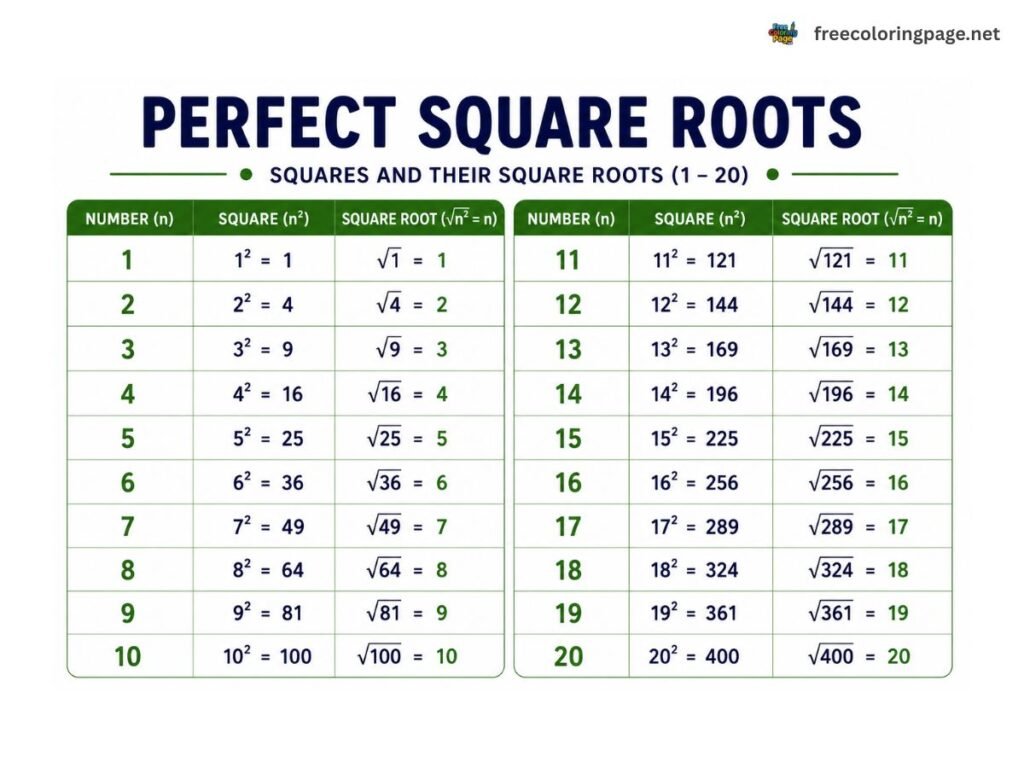
Perfect Squares — Square Roots That Are Whole Numbers
A perfect square is a number whose square root is a whole number. These are worth memorising — they come up constantly in maths, geometry and algebra.
|
Number |
Square root |
|---|---|
|
1 |
1 |
|
4 |
2 |
|
9 |
3 |
|
16 |
4 |
|
25 |
5 |
|
36 |
6 |
|
49 |
7 |
|
64 |
8 |
|
81 |
9 |
|
100 |
10 |
|
121 |
11 |
|
144 |
12 |
|
169 |
13 |
|
196 |
14 |
|
225 |
15 |
|
256 |
16 |
|
289 |
17 |
|
324 |
18 |
|
361 |
19 |
|
400 |
20 |
How to Simplify Square Roots — Simplified Radical Form
Not every square root gives a whole number. But many can be simplified into a cleaner form — for example √72 = 6√2.
To simplify √n, find the largest perfect square factor of n, then split the root.
Example: √72
Factors of 72: 1, 2, 3, 4, 6, 8, 9, 12, 18, 24, 36, 72 Largest perfect square factor: 36 √72 = √(36 × 2) = √36 × √2 = 6√2
More examples:
|
Number |
Largest perfect square factor |
Simplified form |
|---|---|---|
|
√8 |
4 |
2√2 |
|
√12 |
4 |
2√3 |
|
√18 |
9 |
3√2 |
|
√20 |
4 |
2√5 |
|
√27 |
9 |
3√3 |
|
√45 |
9 |
3√5 |
|
√50 |
25 |
5√2 |
|
√72 |
36 |
6√2 |
|
√98 |
49 |
7√2 |
When cannot you simplify? If the number has no perfect square factor other than 1 the square root is already in simplest form. √5, √7, √11, √13 and √17 cannot be simplified — they are already in simplest radical form.
How to Estimate a Square Root Without a Calculator
When you need a rough answer fast, use the two nearest perfect squares as boundaries.
Example: Estimate √52
√49 = 7 and √64 = 8, so √52 is between 7 and 8.
52 is closer to 49 than to 64, so √52 is closer to 7 than to 8.
A good estimate: 7.2 (actual answer: 7.2111…)
The method:
- Find the perfect square just below your number
- Find the perfect square just above your number
- Your answer is between the two square roots
- Estimate where in that range your number falls
This method is accurate enough for most everyday estimation needs.
Square Root of Negative Numbers
You cannot take the square root of a negative number in real mathematics — because no real number multiplied by itself gives a negative result.
Why: A positive number × positive number = positive. A negative number × negative number = also positive. There is no real number that squares to give a negative result.
√−9 = not a real number
In advanced mathematics this leads to imaginary numbers, where i = √−1. But for standard school and university maths the answer to “what is the square root of a negative number” is simply: it does not exist in real numbers.
The square root calculator shows “Not real” for negative inputs on even roots (square root, 4th root etc.). Odd roots of negative numbers do exist — for example ∛−8 = −2 because (−2)³ = −8.
Cube Root and Nth Roots
The cube root (∛) of a number is the value that multiplied by itself three times gives that number.
∛8 = 2 because 2 × 2 × 2 = 8 ∛27 = 3 because 3 × 3 × 3 = 27 ∛−8 = −2 because (−2) × (−2) × (−2) = −8
The 4th root (⁴√) is the value multiplied by itself 4 times: ⁴√16 = 2 because 2⁴ = 16 ⁴√81 = 3 because 3⁴ = 81
Use the tabs in the square root calculator above to switch between square root, cube root, 4th root, 5th root and any custom nth root.
Other Free Tools
- Average Calculator — Mean, median, mode and range
- GPA Calculator — Grade point average on the US 4.0 scale
- Fraction Calculator — Add, subtract, multiply and divide fractions
- Percentage Calculator — Percentage of a number, change and markup
- Ratio Calculator — Simplify, scale and solve ratio problems
Frequently Asked Questions
About This Square Root Calculator
This square root calculator is part of CalcDaysTime — a free suite of date, time and maths tools. All calculations run entirely in your browser. No data is sent to our servers, stored or shared with anyone.
Disclaimer: Results are calculated to 10 decimal places of precision using standard floating-point arithmetic. For applications requiring extreme precision — such as engineering or scientific research — verify results using dedicated high-precision tools.